This year Centre Wellington is proud to host Tour the Trees on Saturday, July 14th, 2018 from 10am-12pm. Our group of riders will be making ten stops throughout Fergus and Elora to learn more about the historic foundation and beauty on which our community thrives.
Registration is $25 per rider and helmets are required. To register please email canadiantreefundtrustee@gmail.com.
A special thanks to the Township of Centre Wellington and the Fergus-Elora Rotary Club for sponsoring this event.
Date: Wednesday, Feb 5th, 2020 Time: 7:30 p.m. to 9:00 p.m. Where: Elora Centre for the Arts, 75 Melville St, Elora Cost: Free for members, $5 non-members Speaker: LINDA SWORD
In 2007, Eden Mills decided to be the first village in North America to “go carbon neutral”, to emit no more CO2 than it absorbs. As we all know, this is easier said than done! Although the village has not yet reached its goal, we have taken the measure of more than 4500 tonnes of emissions, de-mystified their sources, and taken practical steps to bring them down! We’ll fill you in on how and what we have accomplished so far, everything from changing light bulbs to planting trees to an energy retrofit of our 100-year-old heritage community hall to carbon neutrality. Eden Mills Going Carbon Neutral is a recipient of a Clean50 2020 Top Project Award. See our Project Site.
About the speaker: Linda has been involved with Eden Mills Going Carbon Neutral since 2007, with a focus on communications. She prepared the handbook So You Want to Go Carbon Neutral. Linda brings her experience as an arts administrator and writer, from roles with the Canada Council for the Arts, the Great Canadian Theatre Company in Ottawa, international productions, the Board of the Elora Festival and Grand Philharmonic Choir, and the Board of the Concerned Residents Coalition fighting the proposed Hidden Quarry near Rockwood.
Neighbourwoods thanks our 2019-20 Tree Talk Sponsor, the Elora-Salem Horticultural Society.
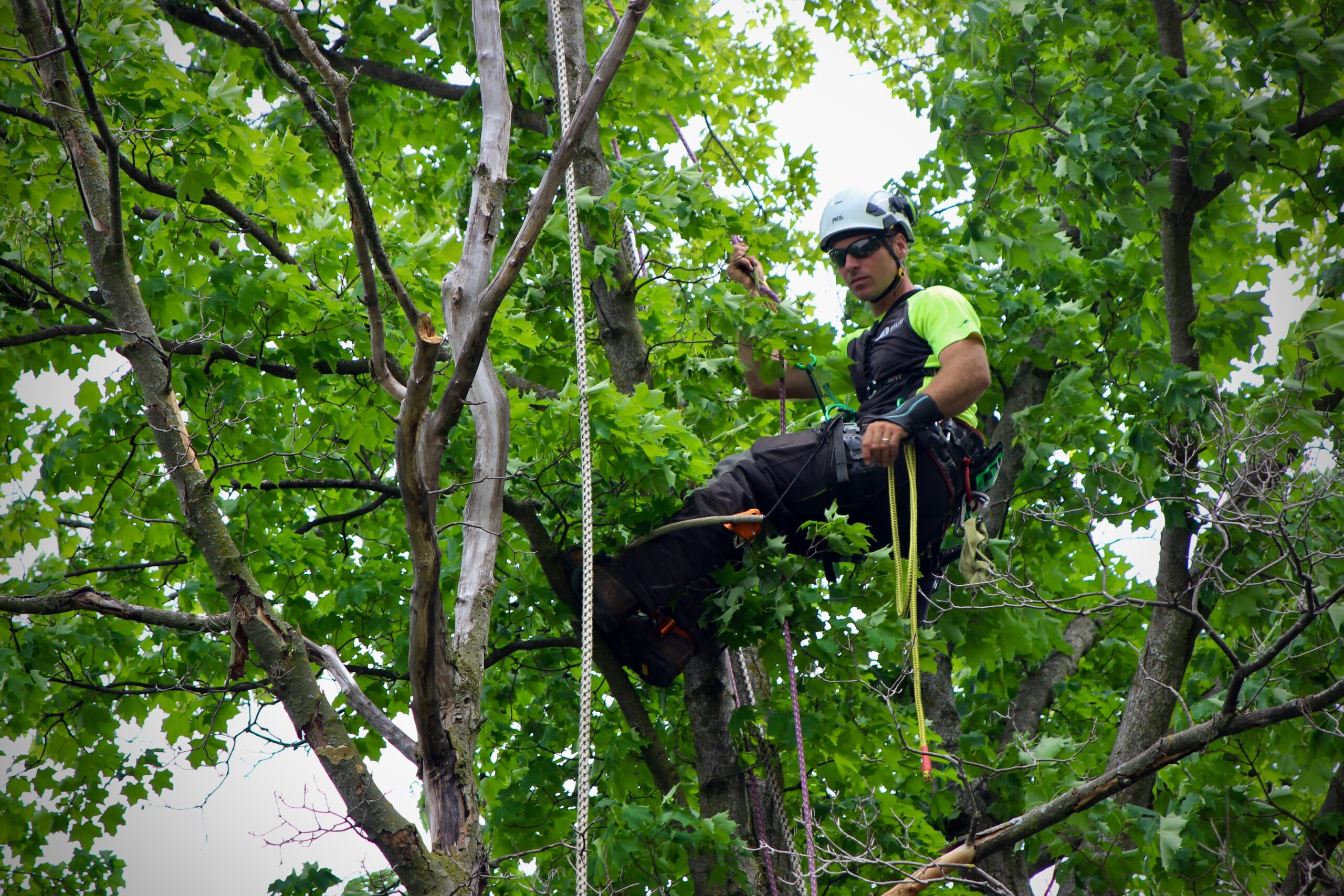
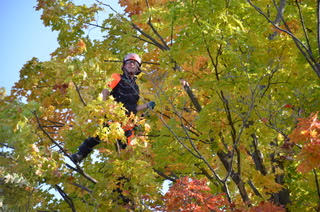
Neighbourwoods encourages residents to hire a qualified arborist to maintain the health andvigor of private trees, and to address potential safety concerns. An arborist can also determine when a tree can no longer be maintained and should be removed due to health, structural concerns, or safety concerns that may impact long-term viability. Tree removal around buildings, vehicles and wires present special challenges.
Although the tree care industry is not regulated, many arborists choose to become certified by the International Society of Arboriculture (ISA) which mandates arboricultural training and continuing education, as well as adherence to the Certified Arborist Code of Ethics. A qualified arborist should be certified with the ISA or a comparable organization, have liability insurance, Workers Safety and Insurance Board (WSIB) coverage, and provide detailed estimates prior to undertaking any work.
If you are looking to have tree work done, there are many qualified contractors working in the Township of Centre Wellington, we invite you to start by visiting the website of the newly formed CW Arborist Association. Every member has volunteered their time and expertise with Neighbourwoods.
Join us for a walk with arborist Kyle McLoughlin. Learn to identify common fungi, the difference between a mushroom and a conk, and see how fungi interact with trees on a daily basis. Ideas discussed in the Role of Fungi in Urban Forestry talk will be expanded. You will be surprised at what you’ll learn.
About the speaker and guide: Kyle McLoughlin is a member of the International Society of Arboriculture Ontario Chapter education committee. He has delivered numerous workshops and lectures on plant pathology and the relationship between trees and fungus. Kyle is the owner and Practicing Arborist of Ironwood Arboricultural Solutions, and has practiced arboriculture in Canada, the United States, and Australia.
Neighbourwoods thanks our 2019-20 Tree Talk Sponsor, the Elora-Salem Horticultural Society, for their support.
This fascinating talk was presented on Oct 17, 2019 by arborist Kyle McLoughlin.
Fungi are not plants – they belong to their own kingdom. In fact, they are more closely related to animals than plants. If you felt there was a lot to absorb at this talk, think about it this way: imagine you knew very little about plants, and a friendly and knowledgeable presenter gave you a 60 minute talk about the plant kingdom – there would be a lot to tell! The world of fungi is similarly complex, and Kyle was a veritable encyclopedia.
Here are a few of the main ideas Kyle covered:
Never eat a mushroom unless you are 100% sure what it is!
An arborist looks for fungi on and around a tree, as part of a tree risk assessment.
If fungi are present on a tree, it indicates a situation that needs to be addressed. It doesn’t automatically mean the tree must be cut down; there are other options.
Fungi, like any organism, are looking for a place to live, eat, and reproduce. The leaves, wood, and roots of trees are all suitable environments for fungi to grow.
Some fungi (the mycorrhizal fungi) are beneficial to trees. They grow underground among tree roots, and enable the roots to take up naturally-occurring phosphorus from the soil, an essential nutrient. In return the fungi receive needed sugars from the tree roots.
The loss of these underground fungal networks due to urban construction projects is a big loss to the trees. Adding artificial phosphorus fertilizer is a poor replacement. Preserving these symbiotic relationships between trees and fungi needs to be a priority.
Other types of fungi can damage trees. Effects can range from the mild (leaf tar spots) to the serious (decay within the tree).
Fungi get into the interior of trees via wounds to the tree, for example those caused by incorrect pruning, storm damage, or lawnmowers and weed-whackers.
Trees don’t heal from wounds; they react by compartmentalizing, or sealing off the area. The tree creates a barrier zone to prevent the invading fungi from spreading.
A tree’s environment affects its health and ability to defend itself against invading microorganisms. The urban environment is generally unhealthy, with nutrient-poor, compacted soil; air pollution; construction damage; root constriction; and proximity to buildings, roads, and other infrastructure.
Some trees eventually fail due to accumulated defects, which causes risk to property and human safety. Our goal is to keep trees healthy and flourishing for as long as possible, to avoid damage or loss, and maximize the benefits they provide.
Some ways of reducing the risks posed by weakened trees include:
Starting off right at the planting stage (right species suitable for conditions; in good soil; not too close to buildings, sidewalks, hydro wires, etc);
Maintaining a variety of native species, of different ages, in the urban forest; mulching, watering, and pruning proactively; protection from construction damage (especially to roots); pruning off dead branches and reducing the weight of living branches.
Tree Walk
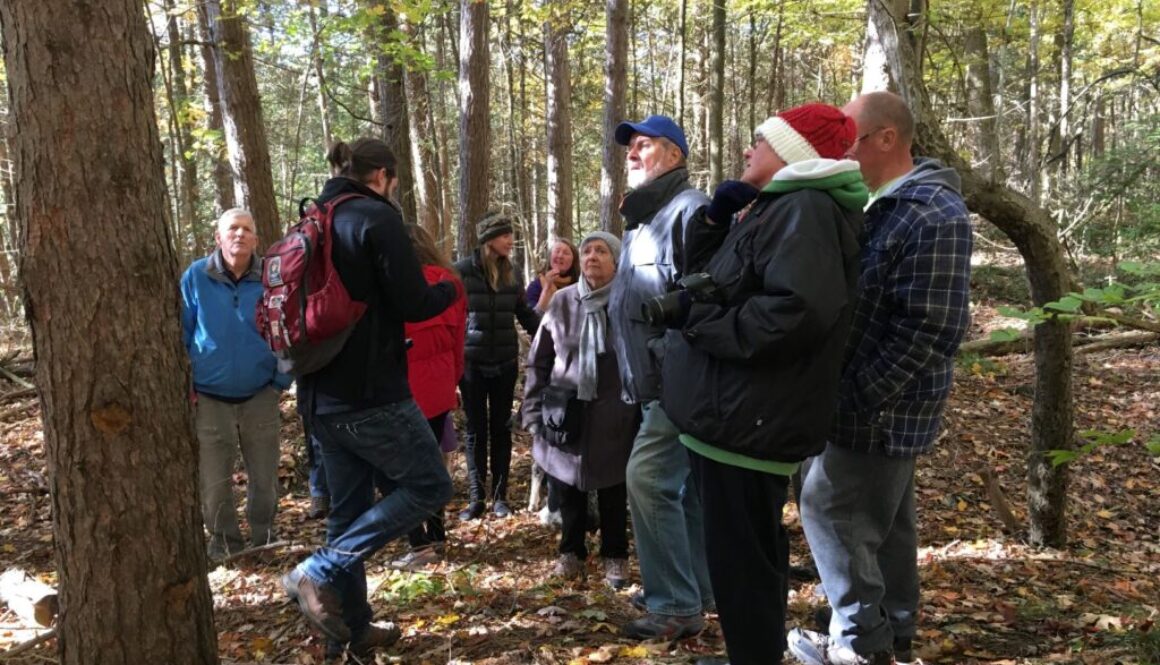
On the Saturday morning following the talk, Kyle took 17 of us on a hike to view a large variety of fungi in the forest. We were amazed at how much there was to see, and just how much there is to learn about the world of fungi.
Neighbourwoods 2019 Spring Tree Talk: raresites: Land Conservation in the 21st Century
On March 26, our guest speaker Tom Woodcock gave us an in-depth look into the what, where, when, why, and how of the rare Charitable Research Reserve.
What is rare? The Reserve is an area of over 900 acres, on the Grand River between Kitchener and Cambridge. Its mandate is to preserve and steward ecologically significant land in Waterloo and Wellington Counties. A sampling of the 24 different habitats under protection include old-growth Carolinian forest; floodplains; meadow and prairie; bird and turtle breeding grounds; and stops along bird migration routes.
Rare’s conservation activities comprise three areas:
Conservation: including tree planting, management of invasive species, and trail maintenance
Scientific research: a living laboratory that hosts environmental research projects and monitoring
Education: public events, environmental education programs, volunteer opportunities, and recreation such as hiking trails, to enable the public to learn about and value their natural surroundings.
Rare is a non-profit organization that depends on volunteers and is funded mainly by donations, and some funding from the region for specific projects.
Why does rare do what it does? We are all familiar with the threats to land and forests from an increasing human population: consumption of living space, food, water, and resources; climate change; loss and degradation of habitat; and pollution.
From one perspective, “undeveloped” land can appear to be inactive, inert, and of no value until a commercial developer comes along to build something on it. From a more accurate perspective, natural landscapes actively provide a huge variety of “ecological services”, including water filtration, flood and erosion control, removal of air pollutants, recycling of nutrients and renewal of soil, pollination, absorption of greenhouse gases, and support for the biodiversity that makes this all possible. These services of course benefit not just humans, but all other species on which we and the earth’s ecosystem depend.
To get a sense of how valuable these services are, ask yourself for example: how do I get clean water? Ecoservices are “free”, but they require the space and time to do their jobs. If ecoservices disappear, replacing them comes at a cost. Consider for example the costs of building a water treatment plant, paying for flood insurance or damage, healthcare costs due to air and water pollution, or the need for more and more fertilizers and pesticides to compensate for diminishing soil quality.
The message is that we are depleting the earth’s natural ecoservices at an unsustainable rate – we are using more than the environment can provide. “Half Earth” is a concept proposed by Harvard biologist E.O. Wilson, which states that we need to set aside and protect one half of the earth’s natural habitats in order to maintain the biodiversity that is essential for the earth’s ecoservices to be sustainable.
What are some solutions? The answer to the question “why conserve land?” became clear. We need to achieve a balance between usage and preservation of natural resources. Rare supports this goal by:
Stewarding land that is already under protection, in perpetuity
Reconnecting fragmented landscapes so that habitats are not disrupted and species have increased chances of survival
Acquiring more lands for preservation, through purchase or donation. For example, a current project is underway to build a conservation corridor along the Eramosa River, that would extend from Eden Mills through Rockwood, Guelph, and the Eramosa Valley. This project has the potential to almost double the area of land under protection by rare.
Underpinning all of these efforts is the need to engage and educate the public as to the value of natural landscapes, not only for their ecoservices but for the enjoyment and well-being they provide.
In case all of these problems seem too large to resolve, we can remind ourselves of Tom’s decription of ecological activity as: “little actions or processes happening an unimaginable number of times”. With that in mind, the small efforts of each of us can potentially add up to a large turnaround in the ways we use and preserve our natural landscapes.
On January 21st, 2019, about 40 enthusiastic community members gathered to hear Fred Redekop give a fascinating overview of a long-running project by the Mennonite Central Committee to reforest the hardest-hit areas in Haiti, to provide local people with affordable food, cooking fuel, and building materials, as well as income from fruit and lumber sales. In addition, the reforestation project improves soil and reduces erosion from wind and water, reducing vulnerability to, and allowing quicker recovery from, natural disasters like hurricanes and droughts.
Fred’s talk included some background on some of the reasons that led to Haiti’s becoming so drastically deforested, including extreme weather but also political and economic pressures both internal and external to Haiti. This generated comments and questions among the listeners, and we were fortunate to have relevant insights shared by participants with first-hand experience in Haiti.
A strong point of the presentation was that MCC works directly with local people and partners, to ensure the aid provided is appropriate to the people’s needs, and is sustainable by them over the long term.
MCC has established local tree nurseries, and provides education, training, and support on sustainable farming practices. The trees are selected specifically for the climate and conditions, and are fast-growing. The project has been underway since 1983; in the past five years alone, over 2 million trees have been planted, of which approximately 400,000 are fruit trees.
The presentation gave us much food for thought, and provided a clear example of how forest conservation is critical to the well-being of people and environments.
Fred Redekop was a pastor in the Mennonite Church for 30 years. At present he is the Church and Community Associate for Mennonite Central Committee; he is also a councillor for the Township of Woolwich. We were delighted that he was able to join us for this special evening.
Neighbourwoods thanks our 2018-19 Tree Talk Sponsor, the Elora-Salem Horticultural Society, for their support.
Date: October 2nd, 2018 Time: 7:30-9:00 Where: Minarovich Gallery Admission is free for members and $5 for non-members.
SERENA SOUCY What is conservation? A simple question, with many differing perspectives. Serena will take us through the history of the conservation effort providing a variety of viewpoints, from people of different nationalities and backgrounds. How are different communities affected by the conservation? Who benefits from it? Come to our tree talk to find out more!
About the Speaker:
Serena is a recent graduate of the University of British Columbia with a degree in Natural Resources Conservation. She has experience working in conservations with Parks Canada, the Creston Valley Wildlife Management Area, and with the UBC Botanical Garden. As a student in the relatively small Faculty of Forestry, she had an optimal experience working closely with staff and professors to get the most out of her degree.
The Elm Recovery Project at the University of Guelph Arboretum
Many people today don’t recall the incredible canopy that the American elm (Ulmus americana) once produced over cities, rural roads and wild landscapes. With the introduction of Dutch elm disease into North America in the mid-twentieth century, hundreds of millions of elm trees were quickly killed – and the fungus continues to cause mortality in this species today.
There is hope. Some elms appear to tolerate infection and remain healthy into old age; they are the survivors. Since 1998, the University of Guelph Arboretum has been conducting the Elm Recovery Project to study and archive these special trees. Lovingly dubbed, ‘A Dating Service for Lonely Elms’ by CBC Radio, the Elm Recovery Project has been bringing these isolated survivors together while providing a helping hand on the path to seeing this majestic species tower over our Ontario landscapes once again.
About our Speaker
Sean Fox is an engaging and knowledgeable speaker and we are delighted he can join us.
He is the Arboretum Manager and Head Horticulturist at the University of Guelph Arboretum where he oversees more than 30 woody plant collections from around the world. During the past 17 years, Sean has dedicated a significant portion of his time to the Rare Woody Plants of Ontario Program and the Elm Recovery Project, both sited at The Arboretum. These plant conservation programs ultimately aim to help protect the unique genetics of Ontario’s threatened species.
Date: Tuesday, April 10, 2018
Time: 7:30 – 9 PM
Location: Minarovich Gallery, Elora Arts Centre, 75 Melville Street, Elora